Featured Posts
Redis, Valkey, or Dragonfly: revisit the choice before you treat them as the same cache
If your service already uses Redis, the name on the port has not changed. The product behind that name has. Treating Redis, Valkey, and Dragonfly as three labels for one cache is the habit worth unlearning.
Read more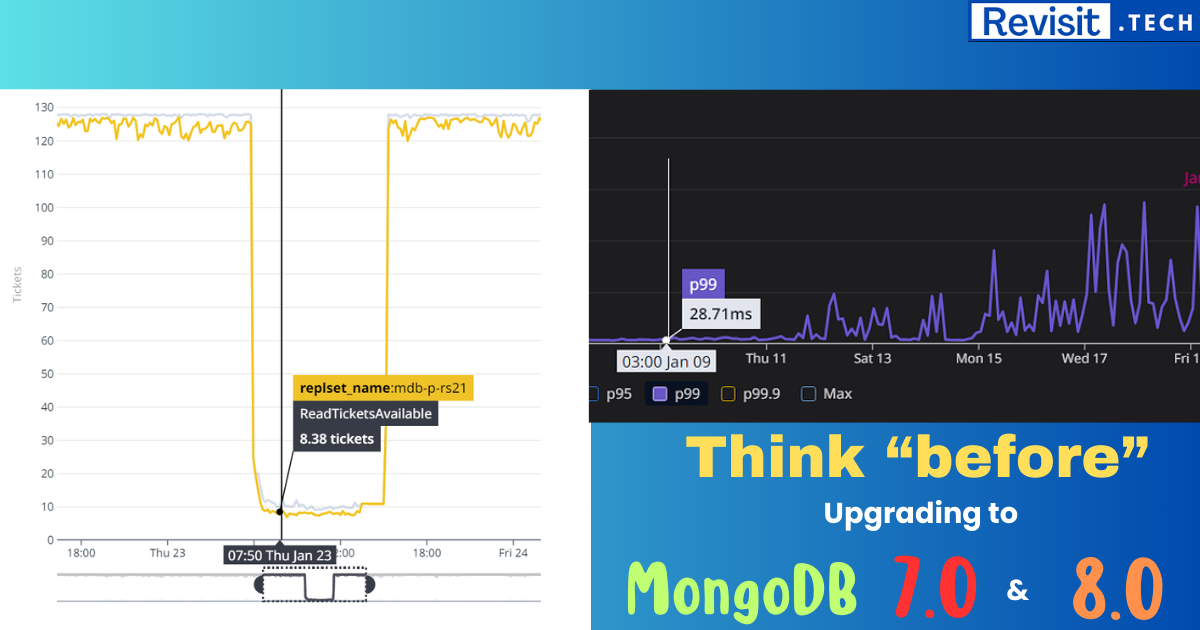
MongoDB 8.0 Performance is 36% higher, but there is a catch…
TLDR: If your app is performance critical, think twice, thrice before upgrading to MongoDB 7.0 and 8.0. Here is why…
Read more
Recent Posts
Redis, Valkey, and Dragonfly clients: revisit your connection settings before the next failover
An order service runs on Valkey with Sentinel. At 2 AM the team runs a planned failover before patching the primary.
Read moreIngress NGINX retirement: revisit your Kubernetes ingress before you migrate
A platform team plans its Kubernetes 1.37 upgrade for the next sprint. The cluster checklist is green, except one line nobody owns: the ingress-nginx Helm chart, pinned at 4.
Read moreRedis, Valkey, and Dragonfly memory and upgrades: revisit before the next spike
A payments team runs its session cache with maxmemory 12gb on a 16 GB node and feels safe. On a festival sale evening a replica reconnects, a reporting job pulls a few huge hashes, and the kernel kills the process while used_memory still shows less than 12 GB.
Read morePostgreSQL asynchronous I/O: revisit your settings before you upgrade
A team upgrades its reporting database from PostgreSQL 16 to 18 over a weekend. On Monday the nightly scans finish a little faster, and nobody knows why, because nobody changed a setting.
Read moreIdempotency keys: revisit your retries before they charge twice
A customer taps “Pay”, the spinner keeps turning, the mobile network drops and the app tries again. Between that phone and your database, an SDK, a proxy or a queue consumer may also try again.
Read moreMinIO and its alternatives: revisit your self-hosted S3 in 2026
For many teams, MinIO was the default answer to one simple need: “give us S3 on our own machines”. It sat behind CI pipelines, backup jobs, data lake experiments and almost every docker-compose file that needed a bucket.
Read more