Featured Posts
Redis, Valkey, or Dragonfly: revisit the choice before you treat them as the same cache
If your service already uses Redis, the name on the port has not changed. The product behind that name has. Treating Redis, Valkey, and Dragonfly as three labels for one cache is the habit worth unlearning.
Read more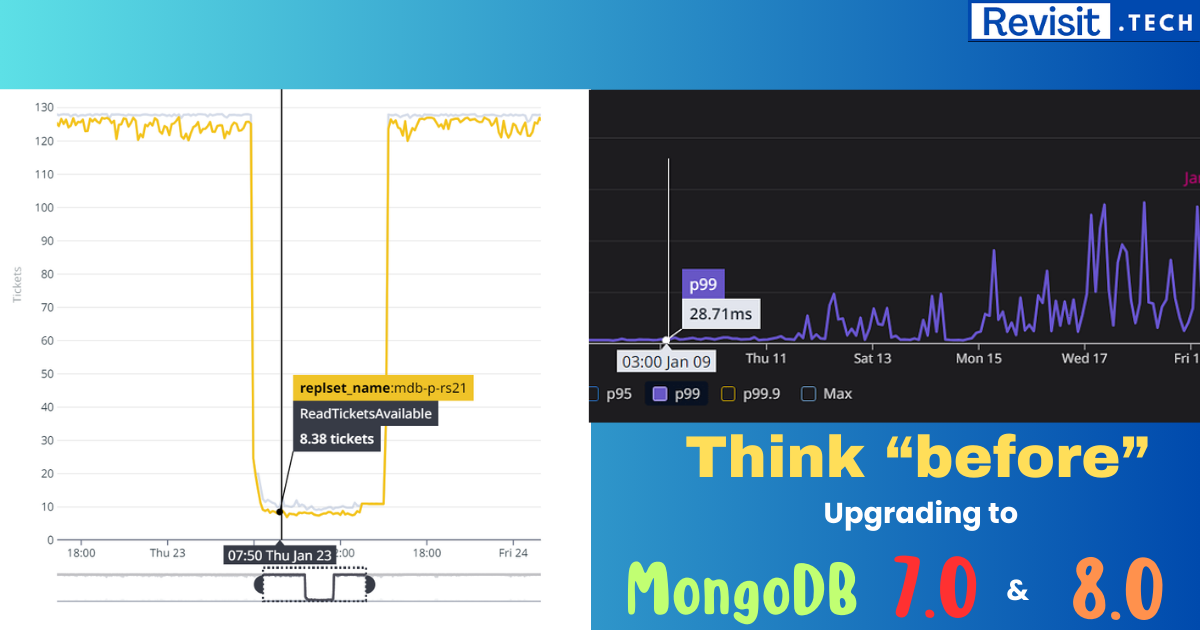
MongoDB 8.0 Performance is 36% higher, but there is a catch…
TLDR: If your app is performance critical, think twice, thrice before upgrading to MongoDB 7.0 and 8.0. Here is why…
Read more
Recent Posts
Python dependency tooling in 2026: revisit pip, Poetry and uv before you rebuild another virtualenv
Every Python team has the same conversation at least once a year. One developer has started using uv on a side project and wants to move every service to it, because installs that took a minute now take a few seconds.
Read moreKubernetes packaging in 2026: revisit Helm, Kustomize and Timoni before you template another YAML file
Sooner or later every team on Kubernetes has the same argument. One person says Helm charts have become unreadable and the team should move to plain YAML with Kustomize overlays.
Read moreServer-side JavaScript runtimes in 2026: revisit Node.js, Deno and Bun before you move another service off Node.js
Every few months someone in a JavaScript team asks the same question: should we move this service to Bun, or to Deno?
Read moreSelf-hosted CI in 2026: revisit Jenkins, Woodpecker CI and Tekton before you add another build agent
Most teams that keep builds on their own servers did not choose their CI engine recently. It was chosen years ago, by someone who may have left, on a machine that has been upgraded “when there was time”.
Read moreServer-side WebAssembly in 2026: revisit Wasmtime, WasmEdge and Wasmer before you run another customer plug-in
Sooner or later, many business products are asked for the same feature: “let our customers write their own rules”. A pricing formula, a validation check, a custom field calculation, a small webhook transformer.
Read moreContainer sandboxing in 2026: revisit gVisor, Kata Containers and Firecracker before you run another untrusted workload
A normal container is a set of Linux processes with namespaces, cgroups, capabilities and a seccomp profile around them. That is a good packaging boundary and a reasonable resource boundary.
Read more